ChatGPT has ads. Give the marketing industry twenty minutes and it’ll invent a webinar, a panic funnel and a slideshow about why you’re already late. You aren’t. The useful question is whether this new placement can reach your buyers at a price your business can support.
Our take: run a small, measurable test if your buyer could plausibly discover you there and your numbers can support it. If either answer is no, keep your money. We promise not to send someone round to confiscate your marketer badge.
In this article
- How ChatGPT ads work
- Who can see them and where
- How ChatGPT decides when to show an ad
- What ChatGPT ads cost
- Whether to run a test now
First, how do ChatGPT ads work?
Imagine a buyer asking ChatGPT “how to choose a CRM for a ten-person sales team?”. ChatGPT writes its answer. An eligible ad can appear below that answer, clearly marked as “sponsored”.
IMPORTANT: The advertiser buys THE PLACEMENT, not a mention inside the answer. OpenAI says ads do not influence ChatGPT’s responses.
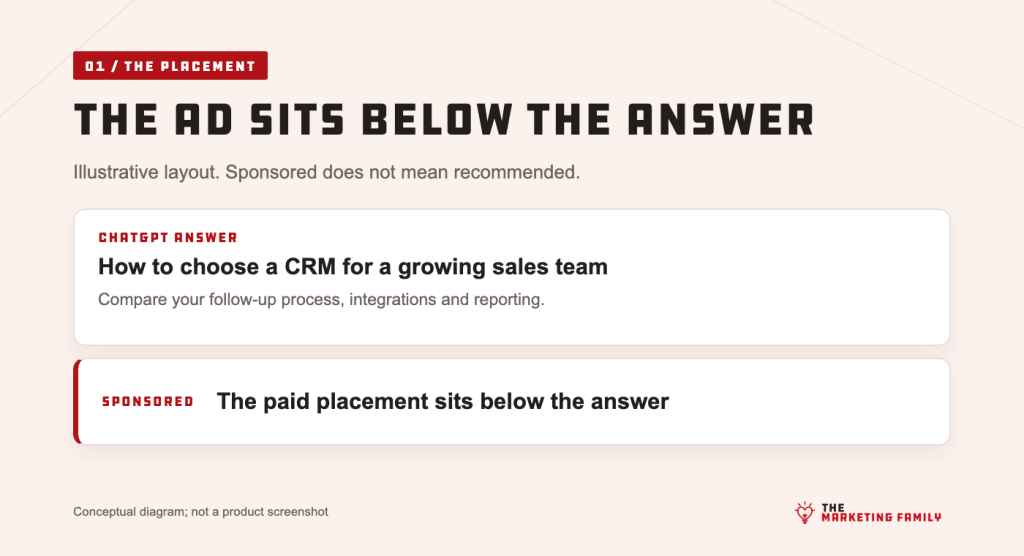
Illustration of the placement, not a screenshot of ChatGPT. The answer and sponsored card are separate.
That’s a useful distinction if you are deciding where to spend. Paying for an ad and getting cited in an AI answer are different jobs. We explain the second one in our guide to SEO, AEO, GEO and AIO. If somebody says buying the ad will make ChatGPT recommend you, that’s bullshit. Put your wallet back in your pocket.
Who can see ChatGPT ads, and where?
OpenAI says ads may appear on Free and Go for eligible adult users. Plus, Pro, Business, Enterprise and Edu accounts do not show ads. So the question is not just, “Do our buyers use ChatGPT?” It is, “Do the buyers we want reach the ad-supported experience?” We would not pretend to know the answer for your market without testing it.
Side note: in an April 2026 interview, OpenAI’s CFO said about 95% of ChatGPT users did not pay. That’s a global figure from a particular point in time, not a readout of your target market. Your buyers could still be concentrated on ad-free plans. Check before you spend.
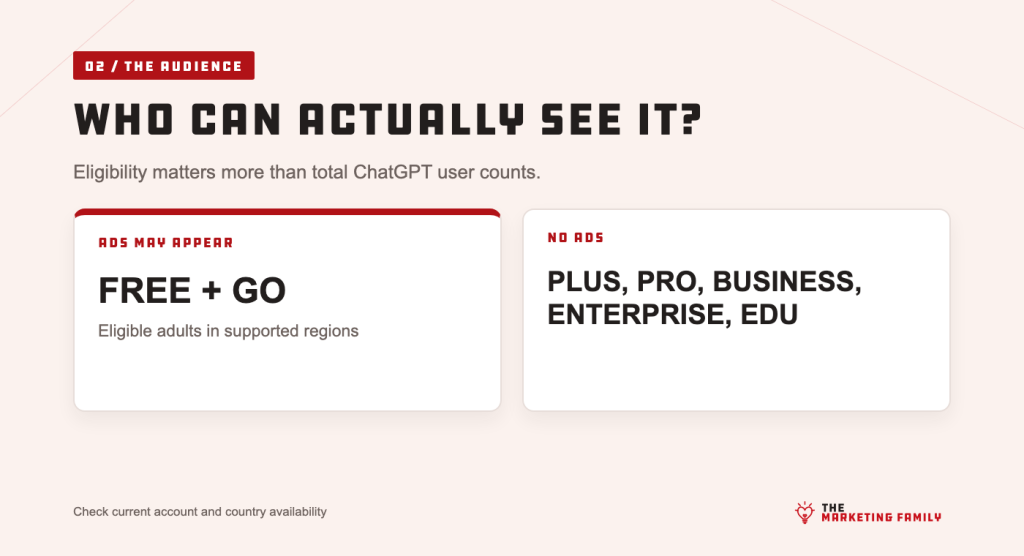
Plan eligibility is one filter. Your buyer’s actual habits are the other.
Self-service Ads Manager availability now covers the United States, the United Kingdom, many European markets and other countries. OpenAI opened self-service access in 31 European markets on August 31, 2026. Check the current country list for the legal entity that will be billed. A signup page alone does not mean your account can run ads in every country on the planet.
How does ChatGPT decide when to show an ad?
You can give OpenAI context hints about the product, the customer and the situation in which it helps. For a CRM, that might be “sales teams replacing spreadsheet follow-up as they grow.” That tells the system something useful about fit. “Show my ad to rich people, please” tells it something useful about your optimism.
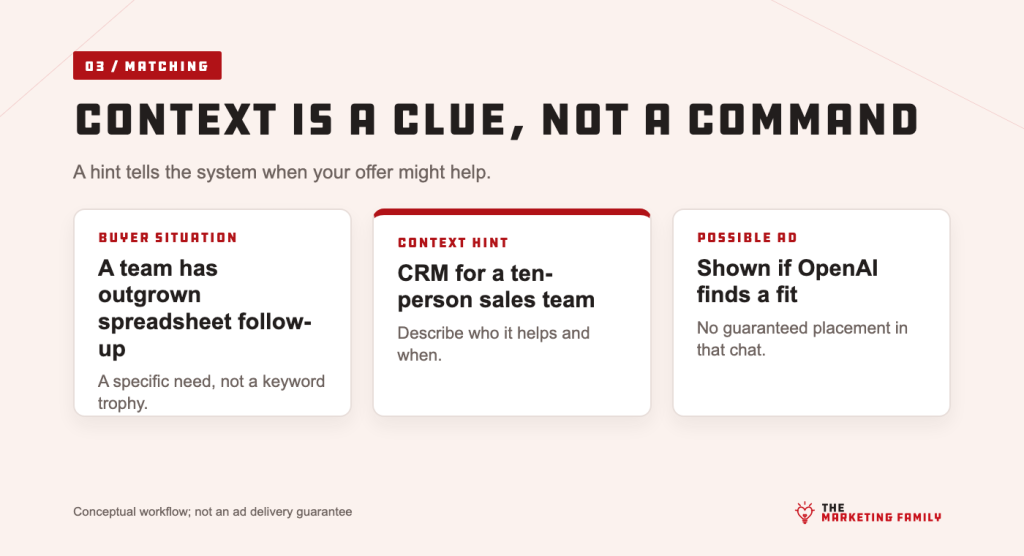
Context hints describe relevance. They do not reserve a particular conversation.
OpenAI says context hints are guidance, not targeting rules. They cannot guarantee delivery in a specific chat. Supported campaign controls can also include location and custom audiences. The system considers the ad, its landing page and the conversation’s context. OpenAI says advertisers do not receive people’s chats or chat history.
For the first test, we’d write a few hints tied to genuine buying situations, check the landing page against the same situations, then look at actual delivery. A vague hint plus a vague page gives the system two opportunities to shrug.
What do ChatGPT ads cost?
You can buy clicks or impressions; conversion-optimized campaigns are also available with click or impression billing. Prices come from an auction, so a bid is not a promised cost. For CPC campaigns, OpenAI suggests an initial maximum bid of $3 to $5 per click. That is a starting bid, not a market-wide benchmark or the amount you will necessarily pay.
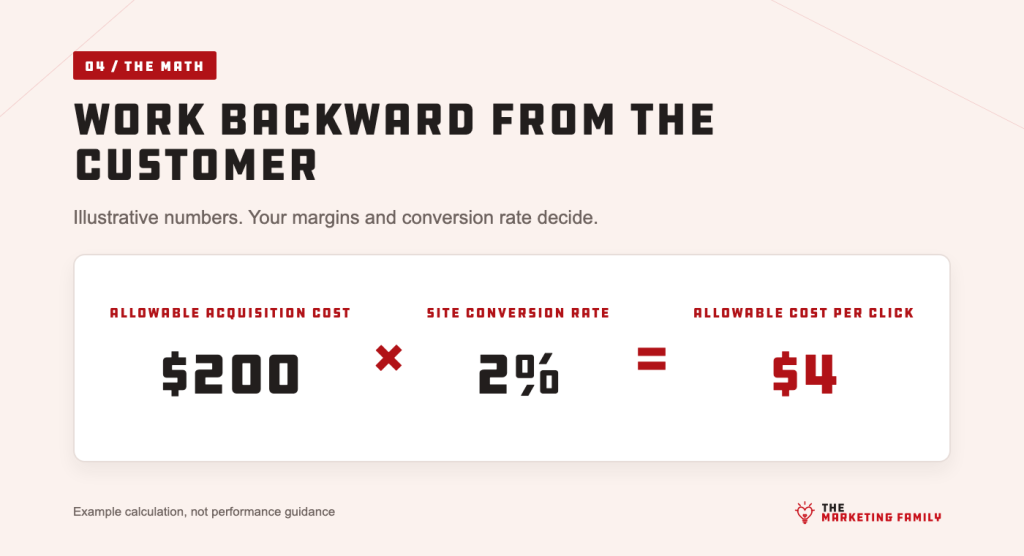
Example maths, not a forecast: $200 allowable acquisition cost times a 2% site conversion rate gives a $4 allowable click cost.
The current minimum daily budget is $25 for USD accounts and 15 euros for EUR accounts. That’s a minimum setting, not a guaranteed spend or a fixed bill. OpenAI says daily budgets are averaged over a week, and a single day can spend up to twice the selected daily amount. Set a campaign-total budget if you need a firm ceiling for the experiment.
Before you choose a bid, work backward from your business. Suppose you can afford $200 to acquire a customer, after accounting for your margins and other acquisition costs. If 2% of relevant ad visitors become customers, your allowable cost per click is $4. Change either assumption and the answer changes. If you don’t yet know your site’s conversion rate, write down a range and treat the first campaign as a measurement exercise.
Be wary of neat price ranges by industry or rules that say you need exactly 400 clicks to know anything. OpenAI says cross-advertiser performance benchmarks are not yet established. A tidy number is lovely until somebody spends real money on it.
So, should you run a test now?
Uh… yes? 🙂 We’d start if three things are true: 1. your buyers ask ChatGPT about problems you solve, 2. your landing page answers those problems clearly, 3. and you can track a meaningful action after the click. A booked meeting, a qualified lead or a sale tells you more than a graph of impressions doing a little dance.
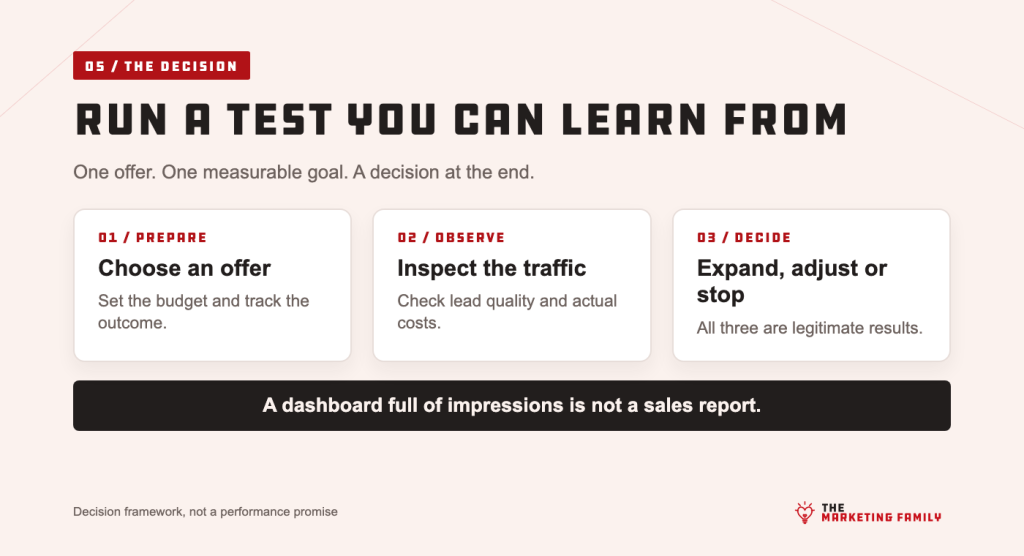
The test ends with a decision: expand, adjust, or stop. All three are useful answers.
Pick one offer and one country you can serve. Define the action you will count before you open Ads Manager. Set up tracking, write context hints tied to real buyer situations and keep the first campaign narrow enough to inspect. Let it run long enough to collect useful data for your own sales cycle. Then compare spend with the quality and cost of the outcomes. There is no magic number of clicks that can rescue a weak offer.
Waiting is a reasonable decision too. The platform is young, and OpenAI says the beta is still evolving. The old argument that every later click must be more expensive was guesswork dressed as urgency. We would rather have a good reason to test than a countdown timer somebody invented on LinkedIn.
If you want help managing a test, Advarde offers software for ChatGPT ads teams and a managed option. Full disclosure: Advarde is part of our extended family, and we’re involved in building it. You can also run the test directly in OpenAI’s Ads Manager. The experiment should stand on its own logic either way.
The useful question is simple: CAN YOUR BUSINESS SUPPORT THE COST TO REACH A BUYER WITH THIS AD PLACEMENT???
One careful test can start answering it. A hundred hot takes cannot.